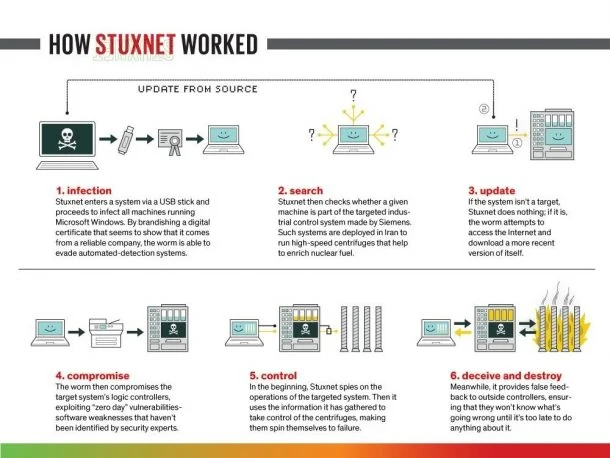
What happened
Security researchers publicly identified a new piece of malware in June and July 2010 after the firm Virusblokada reported, on 17 June, a threat spreading through a flaw in how Windows processed shortcut files. Symantec's technical dossier on the threat, later named Stuxnet, found it used four unpatched Windows vulnerabilities and two stolen digital certificates to spread, then searched infected machines for Siemens industrial control software before attempting to alter code on specific programmable logic controllers while feeding operators data suggesting normal operation. Two advisories from the agency now known as CISA, an initial advisory on the threat and a companion mitigation advisory, confirmed the exploited flaws and affected Siemens products and recommended patching and restricting removable-media use.
Confidence and limits
Symantec's dossier is a detailed reverse-engineering analysis built from thousands of recovered samples and infection telemetry, and it is specific about dates, exploited flaws and code behavior. It is explicit, however, that the malware's intended target, and any connection to a particular government, is analytical inference rather than established fact, cautioning at multiple points that attackers would have the natural desire to implicate another party through embedded strings. Roughly 60 percent of observed infections were concentrated in Iran, a distributional fact the dossier treats as suggestive rather than conclusive of the ultimate target.
Why it mattered
Stuxnet demonstrated, for the first time in public record, malware built to manipulate physical industrial processes while actively concealing that manipulation from the people operating the equipment. The CISA advisories confirmed that the affected software, Siemens' SIMATIC WinCC and STEP 7, is used across a range of industrial sectors beyond any single facility, and that the exploited vulnerabilities included both zero-day flaws and one previously known issue, meaning ordinary patch discipline would have closed part of the attack path.
Defensive takeaway
Review whether engineering workstations that program your industrial controllers are isolated from general office networks and the internet, and whether your organization would detect a controller's logic changing outside of a scheduled maintenance window.
- Can your control system distinguish sensor data being replayed to an operator from the process's actual live state?
- Are removable drives scanned on a dedicated, isolated system before they are connected to any engineering workstation?
- Do you maintain a verified, offline backup of known-good controller logic that can be used to confirm whether current logic has changed?
The technical record here is unusually detailed for an industrial-control incident because the malware itself was recovered and dissected, not merely inferred from its effects. What remains genuinely unresolved in the public dossier and advisories is attribution and precise intended outcome, and readers should treat any confident claim about who built Stuxnet, or exactly what it achieved at its target, as going beyond what these documents establish.
Ask whether your industrial control environment can distinguish a genuine sensor reading from a replayed one, and whether removable media entering a control network is scanned before connecting to any engineering workstation.
A vendor technical dossier, corroborated by two CISA industrial-control advisories on the same malware and vulnerabilities, establishes the technical mechanism in detail; the dossier itself repeatedly labels the intended target and attacker identity as inference from code and infection patterns, not confirmed fact, and this article follows that caution.
Sources & reading trail
Detailed reverse-engineering analysis of the malware's propagation, exploited vulnerabilities, and PLC-manipulation behavior.
vendor-primary · Source published: 30 September 2010 · Retrieved: 16 September 2026
Confirms exploited zero-day vulnerabilities and affected Siemens control-system software.
government-primary · Source published: Not established · Retrieved: 16 September 2026
Government mitigation guidance confirming affected products and recommending patching and removable-media controls.
government-primary · Source published: Not established · Retrieved: 16 September 2026
Official records establish the facts; confidence labels and defensive takeaways are Patch & Proof editorial analysis. This retrospective draft does not imply the site published on the event date.